 |
|
|
 |
Click on Category to add Article
Search
 |
 |
 |
|
 |
|
|
|
Author Waynder
Date Mon Aug 14, 2006 4:09 pm
Views 5677
Description Learn How the Variator, Roller Weights, Clutch, Clutch Springs, Contra Spring, and Torque Driver All Work Together
Category Engine Tech info
Type Tech Facts
Rating No votes [Rate Article]
|
|
Transmission
|
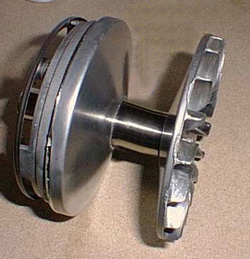
Front Pulley / Variator Assembly

------------------------------------
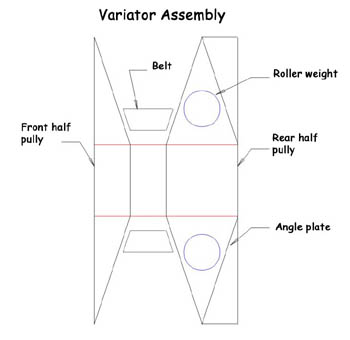 A variator is designed to adjust your rate of acceleration, at what RPM your motor runs while it is accelerating and at what speed the motor is revving when you reach the highest gear ratio available. A variator is designed to adjust your rate of acceleration, at what RPM your motor runs while it is accelerating and at what speed the motor is revving when you reach the highest gear ratio available.
Now having said those things, the key is to have your motor running at about 8000-8500 rpm's consistently while accelerating. This is where your greatest horsepower is generated. If you are accelerating at 5000 rpm's or 9500 rpm's, this will decrease your acceleration because your horsepower is not at it's peak.
Optimal performance is only achieved through trial and error. Changing your contra spring, and then trying different roller weights is how this is achieved.
In order for you to understand which way you need to go with weights and springs, you must first understand how the entire drive train works.
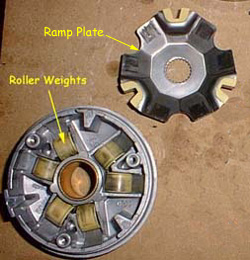
 Lets start with the front pulley of the variator. This is where your roller weights and ramp plate are located. Lets start with the front pulley of the variator. This is where your roller weights and ramp plate are located.
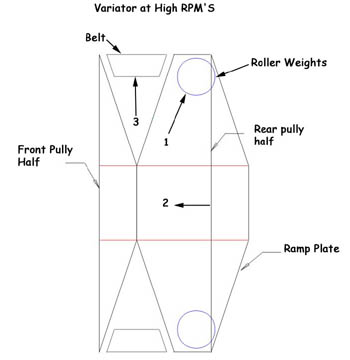
Now as the rpm's of the motor increase, the centrifugal force pushes the roller weights out (Number 1 in picture).
The roller weights push out and onto the angle plates surface. This causes the rear half of the pulley to move toward the front half of the pulley (Number 2 in Picture).
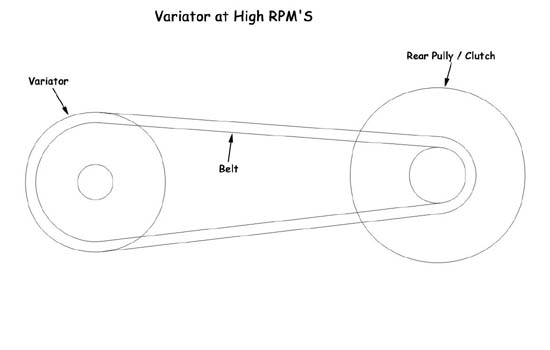
When the rear half of the pulley pushes to the front pulley, it forces the belt out to a higher gear ratio. (Number 3 in picture).
If you are thinking about getting a new variator, Let me first start by telling you that it will probably not have any effect on your over all top speed. What it will do is give you a more steady acceleration. The distance that the rear half of the pulley can travel pretty much remains the same. Meaning that it will only push the belt out as far as the stock variator will which results in the same high gear ratio as the stock variator. The key difference between the stock and performance variators is the angle on which the roller weights travel and the angle on the angle plate in the rear of the variator. This will only help give you a smoother, more constant acceleration.
Now as for the different weights for the rollers. It is really rather simple. The heavier the weight, the more force will be applied to the angle plate forcing the rear pulley forward faster. If the roller weights are too heavy, it will force the gear into too high of a gear too fast.
I like to use a 10 speed bicycle as a comparison. From a dead start, if you are in 10th gear, it is very difficult to get going. But if you are in first gear, it is very easy to get moving. the same principle applies here. You want the weights to keep you in first gear, and as the rpm's increase, it will gradually step the gears up until it reaches tenth gear.
If your roller weights are too light, then there will not be enough force to push the ramp plate out and the rear half forward. This will result in good acceleration, but a low top end.
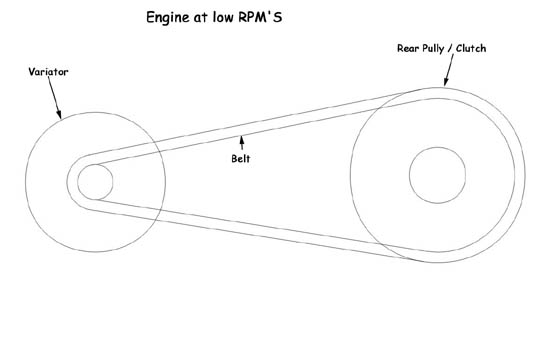
This is what the ratio looks like in low gear. You will see that the front pulley is small, and the rear pulley is large. This is like first gear of the 10 speed bike:
This is what the gear ratio looks like when the roller weights are pushed out and the rear half of the pulley is forward. The belt is pushed out to a higher ratio. This is like tenth gear on the bicycle:
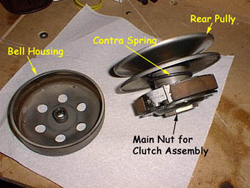
Rear Pulley / Clutch, Contra Spring Assembly
 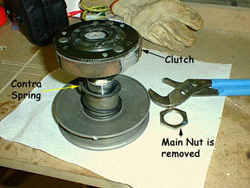
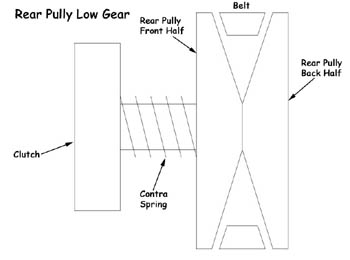
This is what the rear pulley looks like at low rpm's
Now the other factor in this equation is the rear pulley. The rear pulley has a spring holding it together. This is your contra spring.
The front half of your rear pulley is also torque controlled. There are angled grooves that the pulley travels on. As torque is applied, this limits the belt from traveling in too quickly. Likewise, as you go up a hill and torque is applied to the pulley, it is supposed to force the pulley together giving you a lower gear ratio.
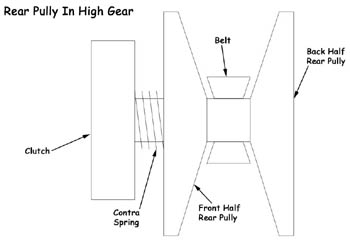
This is what the rear pulley looks like at high rpm's. |
| |
|
|
|
You cannot post new articles in this category
You cannot edit your articles in this category
You cannot delete your articles in this category
You cannot comment articles in this category
You can rate articles in this category
Articles need no approval in this category
Article edits need no approval in this category
|
|
|
|
 |
|
 |
| |


 Calendar
 Home
Home


